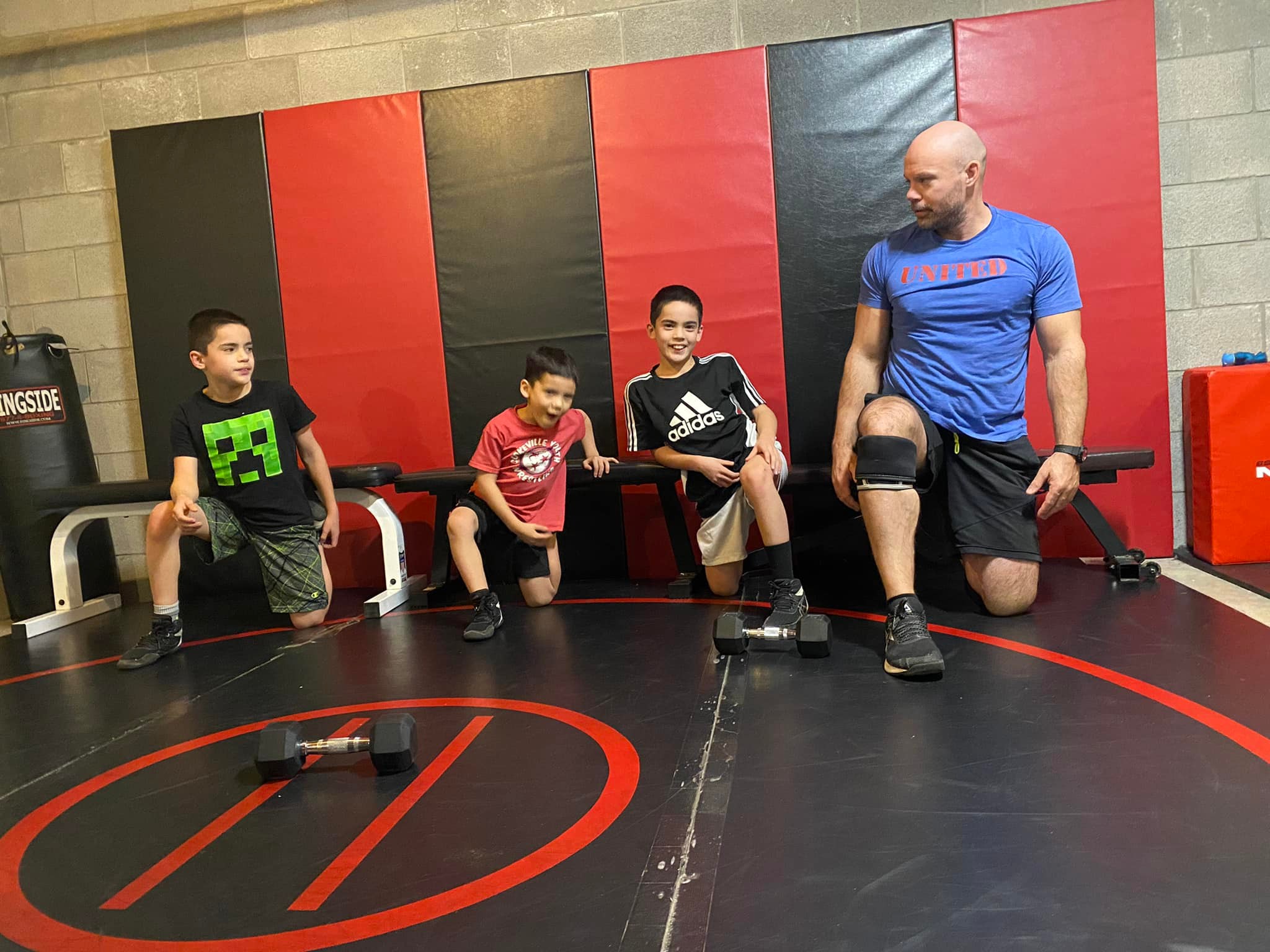
A dad asked me last month at what age his son should start lifting weights. He had been waiting until fourteen. He was not sure where he had heard that number, but he was certain the wait was the safe call.
The answer he was looking for, and the answer most parents do not expect, is four.
Not four years old with a barbell. Four years old learning to move. The strength comes later, on its own, when the body is ready for it. The movement work needs to begin earlier than that, and waiting until fourteen costs a wrestler more than any other decision a parent makes in his early years.
This article is about why that is true, where the wait-until-fourteen myth probably came from, and what to do instead.
Where the myth probably came from
There is no real origin. That is the first thing worth saying. There is no landmark study, no consensus statement, no peer-reviewed conclusion that strength training damages growth plates or stunts development in healthy children. The closest thing to an origin is some misread research on child laborers in the mid-twentieth century, carrying heavy loads under conditions of malnutrition and chronic overuse. That work has nothing to do with supervised strength training in a healthy, well-fed child. The leap from "kids working twelve-hour shifts in factories developed problems" to "a ten-year-old should not learn to squat" requires you to ignore every other variable.
The medical and strength conditioning organizations who actually study this disagree with the myth. The National Strength and Conditioning Association has issued position statements in support of youth resistance training for decades. The American Academy of Pediatrics, the National Academy of Sports Medicine, and the International Sports Sciences Association all say the same thing. Properly supervised strength training in children is safe and beneficial. Not one major body in the field disputes this.
The myth survives anyway, because it sounds protective and because the cost of being wrong about protection feels higher than the cost of being right about progress.
The reframe
Stop calling it strength training. Call it movement training. That single shift fixes most of the confusion in the conversation.
It is ridiculous to put a child on a bodybuilding program. Nobody is asking for that. It is not ridiculous to teach a child a clean and jerk, the same way it is not ridiculous to teach a child to ride a bike, do a cartwheel, or skate backward. The clean is a movement. The squat is a movement. The deadlift is a movement. The question is not whether a child should lift weights. The question is whether a child should learn complex motor patterns under coaching. That answer is obvious. The same parent who would happily enroll a five-year-old in gymnastics or martial arts will, in the next breath, tell you that teaching that same five-year-old a goblet squat is dangerous. The inconsistency does not survive a minute of honest thought.
Why early matters
Complex movements take roughly ten years to master. This is what the motor learning research actually says, and any parent who has watched a kid learn an instrument or a sport already knows it intuitively. The wrestler who is going to peak in his late teens or early twenties needs the movement work to begin a decade earlier. Waiting until fourteen to introduce the clean means the wrestler will still be sorting out his footwork when his competitors have been moving correctly for six years.
The kids who started early do not show up to the high school weight room and learn the lifts. They show up already owning the lifts, and they spend the next four years loading patterns they have had since elementary school. That is the head start the kids who waited will never close.
Christian
My youngest son, Christian, started imitating his older brothers in the garage when he was four years old. He was not lifting anything heavy. He was learning the pattern. The setup. The bar path. The catch. The recovery. He watched Andrew and Alexander and copied what he saw, and what he learned just from watching was more than most teenagers ever pick up from a coach.
Now at ten, he is an expert mover. When puberty hits and he begins loading those movements with real weight, he will not be learning the movements. He will be loading patterns he has already owned for six years. That is the version of strength training that the myth is designed to prevent, and it is the version every young wrestler should have access to.
The safety question, answered
Here is the part the worried parent needs to hear most. A child cannot lift a dangerous amount of weight. His neuromuscular system is not developed enough to generate the force required to hurt himself with a loaded barbell. If Christian walked over to my deadlift bar with two plates a side and tried to pull it, the bar would not move. Christian would walk away unharmed. The weight room is not a place where children get hurt by lifting too much. Children are physically incapable of lifting too much. They get hurt in cars, on trampolines, falling off skateboards, and playing tackle football against bigger kids. They do not get hurt loading a squat to a depth their hips already control.
The actual injury risk in youth strength training comes from two places: bad coaching and ego. Both are addressable. A kid working under a coach who knows what he is doing, with loads chosen for the kid he is, in patterns he can control, is in one of the safest physical activities you can put him in. Safer than the wrestling practice you already drove him to. Safer than the trampoline in the backyard. Safer than the sport he is preparing for.
What to do instead of waiting
Train movement first. Let loading take a natural progression. A child should learn the squat, the deadlift, the clean, the press, the pull-up, and the carry. He should learn them with whatever weight he can control with good form, and he should keep learning them for years. The load will come on its own as his nervous system matures. There is no rush.
The question is not when to start. The question is what to start with. Movement first. Load later. Always in that order.
Want the Full Training System?
Download the free Garage Gym Wrestling Strength Blueprint.
Get the Blueprint