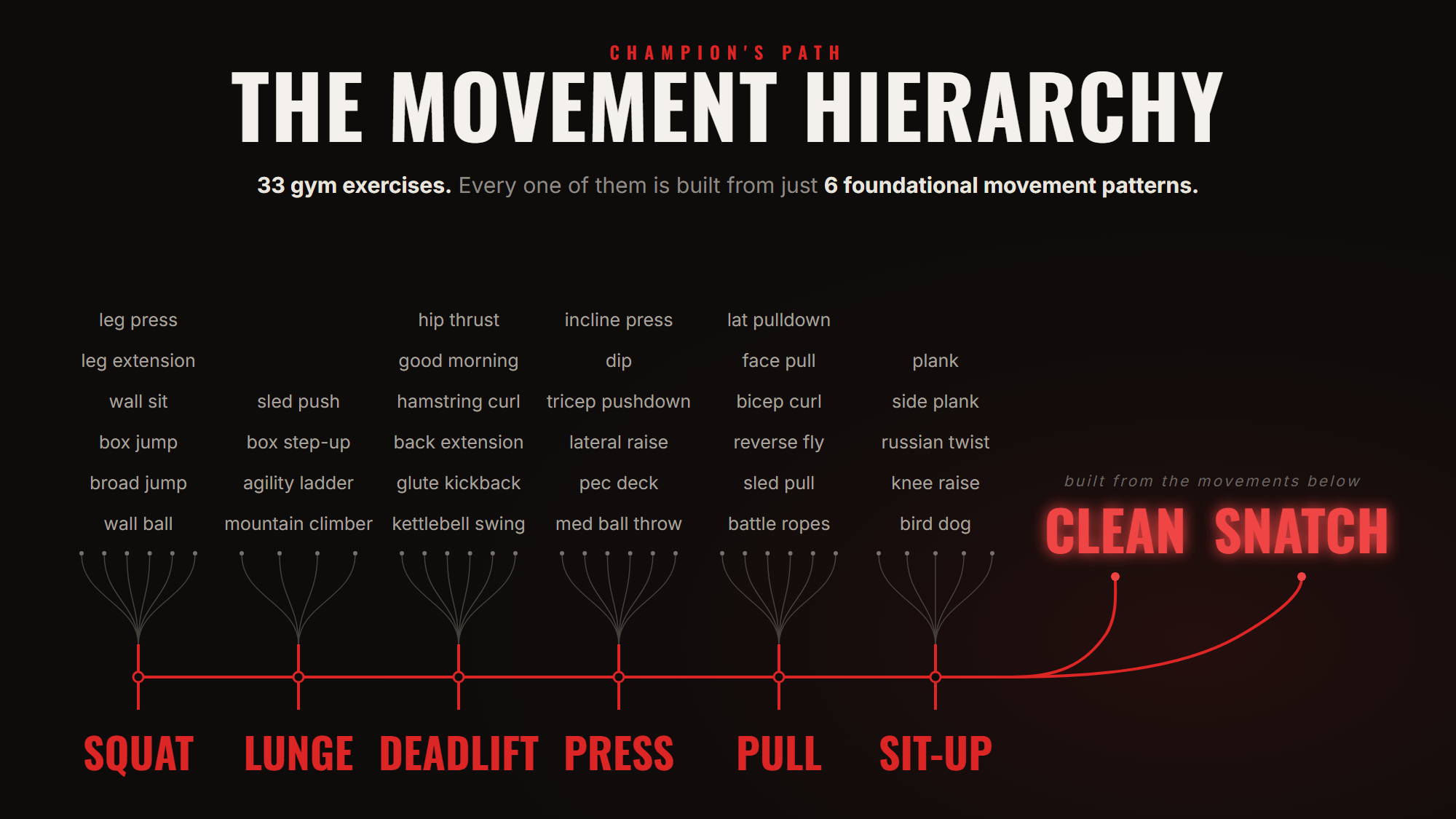
The Movement Hierarchy: Why a Short List of Movements Decides Everything
The Premise
A wrestler has 24 hours in a day, a limited amount of soft tissue, and a training budget split between the mat and the weight room. Every hour spent on a movement with low transference is an hour stolen from one with high transference. That is why a hierarchy exists. It is not a style preference. It is resource allocation under a hard constraint.
The hierarchy rests on one test: does this movement make all other movements better, or does it only make itself better? Apply that test honestly and the field collapses to a short list. Squat and lunge. Vertical and horizontal press and pull. Hinge and anterior trunk. Then the full body lifts that weld all of it together. These movements must be trained weekly and taken to an elite level, because everything else in the gym is a variation of them, a segment of them, or a combination of them. Master the parents and you own the children without ever training them directly. Train the children and you own fragments.
The logic below proves it region by region, then shows why the sport demands one more layer on top.
The Legs: Two Geometries, Two Movements
The lower body only has two possible geometries. Your feet are either parallel or they are split. Every leg movement a human can perform, loaded or unloaded, on a mat or under a bar, is one of those two stances taken through flexion and extension. The squat owns the parallel geometry. The lunge owns the split geometry. There is no third option. Master both and you have mastered the complete positional alphabet of the lower body.
The squat is the parent pattern of bilateral force. Triple flexion and triple extension of the ankle, knee, and hip with the load centered between the feet. Decompose the other movements and the squat is inside all of them. A vertical jump is a squat performed at maximum velocity. A box jump is a squat that leaves the ground. A thruster is a squat that becomes a press. A wall ball is a squat that becomes a throw. A level change on the mat is an unloaded squat, and a level change with an opponent hanging on your neck is a loaded one. None of these contain anything the squat does not contain. They are the squat plus a modifier: plus speed, plus a catch, plus a press, plus an opponent. If the squat is weak or shallow, every one of those children inherits the defect. This is why the kid who claims a 400-pound squat but has never been below parallel cannot take 95 pounds to depth and cannot change levels without collapsing. The parent pattern was never built, so nothing downstream works.
The lunge is the parent pattern of unilateral force, and unilateral is where wrestling actually lives. A wrestling stance is a staggered stance. A penetration step is a loaded lunge with the trail leg driving. Sprinting is built on the same pattern lineage: a chain of alternating single-leg drives at velocity, which is why sprint speed tracks with split squat strength and not just squat strength. The lunge is inside the sprint. That does not mean lunging replaces sprinting, because sprinting adds elastic and cyclical qualities the lunge does not train alone, but the pattern underneath is the lunge, and a broken lunge caps the sprint. A step-up is a lunge with the range compressed. A single-leg finish on a shot, driving up and through with the opponent's weight hanging on one side, is a lunge under asymmetric external load, which is the harshest test of the pattern that exists. The lunge also trains what the squat structurally cannot: the pelvis resisting rotation and lateral shift while one hip produces force and the other stabilizes. That stability under load is the invisible 95 percent of every stance, every angle change, and every scramble where the feet are never parallel. On the mat, they almost never are.
Squat plus lunge covers both stances, symmetric and asymmetric loading, bilateral and unilateral force production, through full range of motion. Every other lower body movement is either a fragment of one of them or one of them plus a modifier. A leg press is a squat with the trunk removed. A leg extension is one joint of a squat. Fragments subtract the bracing, the balance, and the joint sequencing that wrestling requires, which is exactly why they transfer almost nothing.
The Upper Body: Two Axes, Four Patterns
The shoulder is a ball joint, so upper body force can be expressed anywhere across a hemisphere. But every vector in that hemisphere is a blend of exactly two orthogonal axes: vertical and horizontal. Press and pull along both axes and you have covered the complete coordinate system of upper body force. Every other upper body movement is either a point somewhere between those axes or a fragment of one of them. Four patterns own the map. Everything else is a location on it.
The vertical axis is the axis of controlling a body against gravity. The strict press builds raw overhead force through a braced trunk, and on the mat that is the post, the elevated leg on a single, and the frame that holds while an opponent's weight drives down through it. The push press belongs here as the overloaded version of the same pattern. It lets the shoulders and arms handle loads the strict press cannot yet move, which forces adaptation at the top end of the vertical press. On the pulling side, the pull-up is vertical pulling calibrated to the one load that matters most, the athlete's own bodyweight. Wrestling is a bodyweight-relative sport. A wrestler who cannot pull his own bodyweight cannot climb an opponent in a scramble, cannot finish a snap-down against a heavy head, and cannot control a body that weighs what he weighs. High-volume and weighted pull-ups also tax the grip on every rep. The rope climb adds the demand the bar cannot: a thick implement with no knurling, hands releasing and regripping under load, one arm supporting bodyweight while the other fights for the next position. That is grip the way the mat asks for it, broken and refought, not held.
The horizontal axis is the axis of the tie-up. Wrestling's upper body war is fought at chest level between two upright bodies, which makes it horizontal by definition. The bench press and push-up are the force behind the shuck, the cross-face, the post that creates an angle, and the press that gets an opponent off your chest when a scramble goes bad. The push-up matters alongside the bench because it is closed-chain and bodyweight-relative, so the trunk participates the way it does on the mat. The row is the other half of the tie-up. Underhooks, bodylocks, snapping a posture down and into you, dragging an arm across, every one of those is a horizontal pull against a resisting load. A wrestler with a strong bench and a weak row can push an opponent away but cannot bring one in, and wrestling scores by bringing people in.
Take any upper body movement and it resolves into these four patterns or a fragment of them. A lateral raise is one joint of a press. A curl is one joint of a pull. A medicine ball chest throw is a bench press plus velocity. A muscle-up is a vertical pull that becomes a vertical press. An incline press is a point at thirty degrees between the two press axes, and if you own zero degrees and ninety degrees at full range and heavy load, you own thirty degrees without ever training it. Battle ropes are rapid, low-load, partial-range press and pull cycles, a fragment on both axes at once. They have a narrow legitimate use as low-impact conditioning for an athlete managing an injury, but as a strength tool they are fragments, and fragments do not transfer. That is what transference means mechanically. The four base patterns at both axes contain everything, so they transfer to everything.
The Hip: One Cycle, Two Halves
The squat and lunge own the leg geometries. The presses and pulls own the shoulder's hemisphere. The hinge and the anterior trunk own the axis that connects them: the opening and closing of the body around the hip. Wrestling is fought inside that cycle. Every shot, sprawl, and scramble is the body closing at maximum speed or opening at maximum force, and usually both within the same second.
The hinge is maximum hip extension with a rigid spine, and it is the engine of every score. The deadlift is the parent pattern: the highest load a human can move, produced by the posterior chain and transmitted through a braced trunk. The clean is a deadlift plus speed plus a catch. The snatch is the same chain with more speed and a longer path. The kettlebell swing is a ballistic hinge with the load projected. The RDL and good morning are the deadlift with the range or load position shifted. The hip thrust is a hinge with the spine removed from the equation, which is exactly the part wrestling refuses to remove, so it is a fragment. On the mat, the hinge is the finish driving hips through a shot, the sprawl throwing the hips back and down, the stand-up, the mat return, and every lift of an opponent's bodyweight off the mat. A wrestler who cannot hinge cannot finish, because finishing is hip extension against a resisting load, which is the definition of a deadlift.
The anterior trunk is the other half of the cycle, and it is the half almost every program skips because it does not look like strength. Sit-ups, leg raises, and toes-to-bar train the body closing under load: hip and trunk flexion produced at speed. That is the level change, the knees pulling through on a shot, the legs snapping away from an ankle pick, and the curl that keeps a wrestler off his back when a scramble goes bad. The hinge and the anterior trunk are antagonists around the same joint, which means owning one without the other builds half a cycle. The third pull of the clean makes the pairing visible inside a single movement: full extension to full flexion in a flash, a deadlift and a leg raise welded together, which is also the exact sequence of a level change into a shot.
The fashionable counterargument says the core exists to resist movement, not produce it, so planks and anti-rotation work should replace sit-ups. The premise is half right and the conclusion is wrong. Isometric bracing is trained in this system, inside every deadlift, squat, and press rep, where the trunk holds rigid against real load. What the plank crowd removes is flexion production, and wrestling demands flexion production, not just resistance. The level change proves it every match. A wrestler who only braces has trained half the cycle and lost the half that scores. Wrestlers who skip anterior trunk work lose every scramble that goes to the back, because the scramble to the back is a trunk flexion contest and they never trained the pattern.
Every posterior chain movement is the deadlift or the deadlift plus a modifier. Every trunk movement is flexion under load or a fragment of it. A back extension is one segment of a hinge. A plank is an isometric fragment, resistance without production. A knee raise is a partial leg raise. A GHD sit-up is the leg raise with the range extended and the load amplified. Own the deadlift family and the sit-up and leg raise family at full range and real load and every fragment is covered without being trained.
The Capstone: Full Body Lifts and the Two Kinds of Strength
Everything above establishes the alphabet. The final argument inverts the logic, because wrestling is never spoken one letter at a time. No wrestler on any mat has ever performed an isolated squat, an isolated hinge, or an isolated press. Every scoring action is patterns chained in sequence under load at speed. The clean, snatch, thruster, and jerk are the only movements in the gym where the patterns are trained the way the sport uses them: welded together, sequenced correctly, and expressed as one continuous act of power.
One condition governs this entire section. Elite emphasis on the full body lifts assumes the base patterns are already competent, because you cannot sequence patterns you do not own. A kid snatching over a broken hinge is not training power. He is rehearsing a defect at speed. The order is fixed. Build the alphabet, then build the sentences.
The base patterns build force. The full body lifts build the transmission. A wrestler can own an elite deadlift, an elite squat, and an elite press as three separate capacities and still fail to score, because the mat never asks for them separately. The shot asks for a hinge that becomes a triple extension that becomes a level change that becomes a drive, all inside one second. What separates the athlete who scores from the athlete who stalls is not the size of any single pattern but the speed and fidelity of the handoff between them. That handoff is a trainable skill, and the full body lifts are the only place in the weight room it gets trained. The clean is a hinge handing off to an extension handing off to a flexion handing off to a front squat, with a barbell grading every transition instantly. Slow through the middle and the bar crashes. Out of sequence and the bar drifts. The mat grades the same errors, but the barbell grades them in a way you can measure, load, and repeat.
Two definitions carry the rest of the argument.
Slow strength movements are movements where the rep can be completed at any velocity, including a grind. The deadlift, squat, bench, strict press, row, pull-up, and thruster all qualify. If the bar nearly stalls at the sticking point, the lifter can keep applying force and finish the rep. Velocity is an outcome of these lifts, not a requirement of them. That is their virtue and their limit. The virtue is that they can be loaded to absolute maximum, because a one rep max is by definition a grind, and absolute force is built at the grind. The limit is that nothing in the movement punishes slowness. A wrestler can add fifty pounds to his deadlift while getting no faster, because the lift never asked him to be fast.
Fast strength movements are movements with a velocity threshold below which the rep does not exist. The clean, snatch, jerk, box jump, and broad jump all qualify. If the bar does not reach a minimum height at a minimum speed, there is nothing to catch and the rep fails. No amount of grinding rescues a slow snatch, because the grind is not available. Speed is not a coaching cue in these lifts. It is a completion requirement enforced by physics, which means every successful rep is proof that force was expressed fast. You cannot teach a velocity threshold with a movement that has no velocity threshold, which is why these lifts cannot be replaced.
The test that separates the two categories is one question: can you grind it? If yes, it builds slow strength. If a slow rep is a failed rep, it builds fast strength.
Within the full body family, the division matters. The clean, snatch, and jerk are the fast strength members. The thruster is the slow strength member, a front squat handing off to a press, and that exact handoff, legs generating force that the arms finish, is every elevated single leg finish and every opponent lifted and returned to the mat. Because the thruster can be ground through under fatigue, it belongs in metcons, where the grind under fatigue is the trainable quality.
The physics underneath is the force-velocity curve. Power is work divided by time, and wrestling is decided by power, not strength. Two wrestlers with identical strength are separated by who expresses it faster. Force and velocity trade against each other along one curve, and an athlete's capacity lives along the whole curve, not at one point. The slow strength lifts raise the high-force end. The fast strength lifts raise the high-velocity end and train the rate at which force develops, because the window to apply force in a snatch is a fraction of a second. Wrestling scores in that fraction. The shot window, the sprawl reaction, and the scramble exchange are all decided in the time it takes a bar to travel from the hip to the shoulders. A program built entirely on slow strength raises one end of the curve and leaves the end the sport is contested on untouched.
The Tier Logic
The hierarchy now writes itself.
Tier one is the parent patterns and the full body lifts that combine them: squat, lunge, deadlift, strict press, push press, bench press, row, pull-up, rope climb, push-up, sit-up, leg raise, toes-to-bar, clean, snatch, jerk, thruster, and the jumps. These are trained weekly, progressed continuously, and taken to an elite level, because every one of them either is a parent pattern or chains parent patterns in the sequences the sport demands. They cover both leg geometries, both upper body axes, both halves of the hip cycle, and both ends of the force-velocity curve. Nothing in wrestling falls outside what they train.
Everything else is secondary or lower, and the reason is structural, not stylistic. Every other movement in existence is one of three things. A variation, which is a parent with the range, angle, or implement shifted, covered automatically when the parent is owned at full range and real load. A segment, which is a parent with the trunk, the sequencing, or a joint removed, and the removed part is exactly what wrestling demands, so segments transfer almost nothing. Or a combination, which is parents chained together, and the tier one full body lifts already train the chaining at higher loads with instant feedback. There is no fourth category. Any movement anyone ever shows you resolves into one of the three, and if you cannot tell which base patterns it is built from, you do not understand it well enough to program it.
The sport imposes chained patterns under load at maximum velocity with zero pause between phases. That is the demand. By the SAID principle, the training must impose the same thing. Training the patterns separately builds the parts. Training the full body lifts builds the machine. A program that maxes the base patterns but treats cleans and snatches as accessories has built a wrestler with a big engine and no drivetrain, and the third period exposes him, because segmented capacities fall apart exactly when fatigue attacks the transitions first. The transitions are the first thing fatigue steals and the last thing most programs train.
Time and energy are finite. The short list yields the highest return. That is the hierarchy, and it is why these movements are trained every week and taken to an elite level while everything else waits its turn or never gets one.