Every season a parent tells me some version of the same thing: "It's bench press. He lays down and pushes. Why does he need coaching for that?" Usually it comes with a follow-up about the power clean, which looks to them like a complicated way to waste time a wrestler could spend drilling. I understand the logic. It is also wrong in a way that costs wrestlers real points in real matches, and I can show you exactly where.
Here is the claim this article stands on: strength movements are skills, the same way a double leg is a skill, and the lifts that look the most complicated are the ones that transfer the most to the mat. Nobody watches a kid hit a slide-by and says there is nothing to it. The weight room deserves the same respect, and once you see why, your wrestler's training will make sense in a way it probably never has.
Ugly deadlifts prove my point, not yours
Start with the phrase parents actually use: "ugly deadlift." Think about what that phrase admits. You cannot have an ugly version of a movement that has no technique. Nobody talks about an ugly light switch flip. The moment you can look at two kids pulling the same bar and see that one looks right and one looks like a car accident, you have conceded that there is a skill involved, because skill is the only thing separating them.
I have watched this play out with hundreds of wrestlers since 2008. Watch a kid grind out an ugly max deadlift, back rounding, bar drifting away from his shins, half his effort spent fighting his own position. A parent sees the bar go up anyway and concludes technique must not matter much. They have it exactly backwards. That lift is proof of wasted capacity. His muscles produced far more force than the bar ever received, and the leaks at every joint ate the difference. Here is the part worth remembering: fix the positions and the same muscle moves a heavier bar. He sets a new max without gaining an ounce of tissue, because strength he already owned finally reached the bar. Technique is free strength, and it is the only kind that does not cost months of training to acquire.
This is the core mechanical idea, and it comes from Greg Glassman, whose work shaped how I build training: power is technique dependent. Power equals work divided by time, and how much of your raw effort becomes actual work is determined by movement quality. An unskilled lifter is like a kid sprinting with his arms flailing and his knees caving. He is burning enormous energy and delivering a fraction of it. The weight room is where a wrestler learns to close that gap, and closing that gap is a learning process, not a lifting process.
Hardware and software
Here is a distinction worth keeping, because it explains why the "complicated" lifts earn their place. Training changes an athlete in two ways. Strength and endurance are hardware upgrades. The tissue itself changes and the muscles contract harder. Coordination, balance, accuracy, agility, and speed are software upgrades. The change happens in the nervous system. The brain writes new code for moving the body. Neither one alone is the engine. The engine is your kid's average power output across a task, whether that task is a six-minute match or a fifteen-minute conditioner, and it is hardware and software running together. That is why two kids with the same muscle can post very different times on the same workout.
A bicep curl is almost pure hardware. The bench press is where parents think this argument ends, so let me take it head on. Bench is simpler than the Olympic lifts. The pressing action runs through three joints, the wrist, the elbow, and the shoulder, while a clean involves every joint in the body. But simpler is not the same as skill-free, and a properly performed bench press is a full-body lift. The feet stay planted and press into the floor. The core is tense and arched. The shoulder blades are pinched together and stay pinned to the bench. The elbows have to track a precise path, which is exactly where untrained kids fail when they flare and wing them. Bench is like throwing darts. It is visibly the simplest movement in the room, and like darts, it can be mastered over a lifetime. The kid who learns those positions presses more weight with healthier shoulders, and the gap between him and the kid who just lays down and pushes shows up on the bar within weeks.
The clean and the snatch sit at the far end of the same continuum, and they upgrade hardware and software in the same rep. To clean a barbell, a wrestler has to produce maximum force from the hips, transfer it through a braced trunk, and then re-position his entire body under a moving load in a fraction of a second. That is strength, speed, coordination, accuracy, balance, and timing in one movement. Wrestling is a software-dominant sport. Matches are won by nervous systems, not just by muscles. A wrestler who only builds hardware is a fast computer running bad code, and the Olympic lifts are the only barbell work that debugs the code while it builds the machine.
The clean is a double leg with a barbell
Now the transfer question, because "when will he ever need to snatch?" deserves a direct answer. He will never snatch in a match. He will fire the snatch's driving pattern in every match he ever wrestles.
That pattern is triple extension, the simultaneous violent opening of the ankles, knees, and hips. It is the finish of a penetration step. It is the lift on a high crotch return. It is every throw, every sprint, and every explosive standup.
If triple extension were the whole story, you could swap the clean for a loaded jump and lose nothing. Plenty of programs make exactly that trade, replacing the Olympic lifts with trap bar jumps, and they keep the extension while throwing away the half of the lift that is hardest to find anywhere else in training. The extension is only phase one. The instant the bar leaves the hips, the lift reverses, and the wrestler who just drove upward with everything he has must now pull himself downward at maximum speed to get under the bar. That is a change of direction under load, the same quality that shows up in a level change or a duck-under, and it is agility trained with a barbell in your hands.
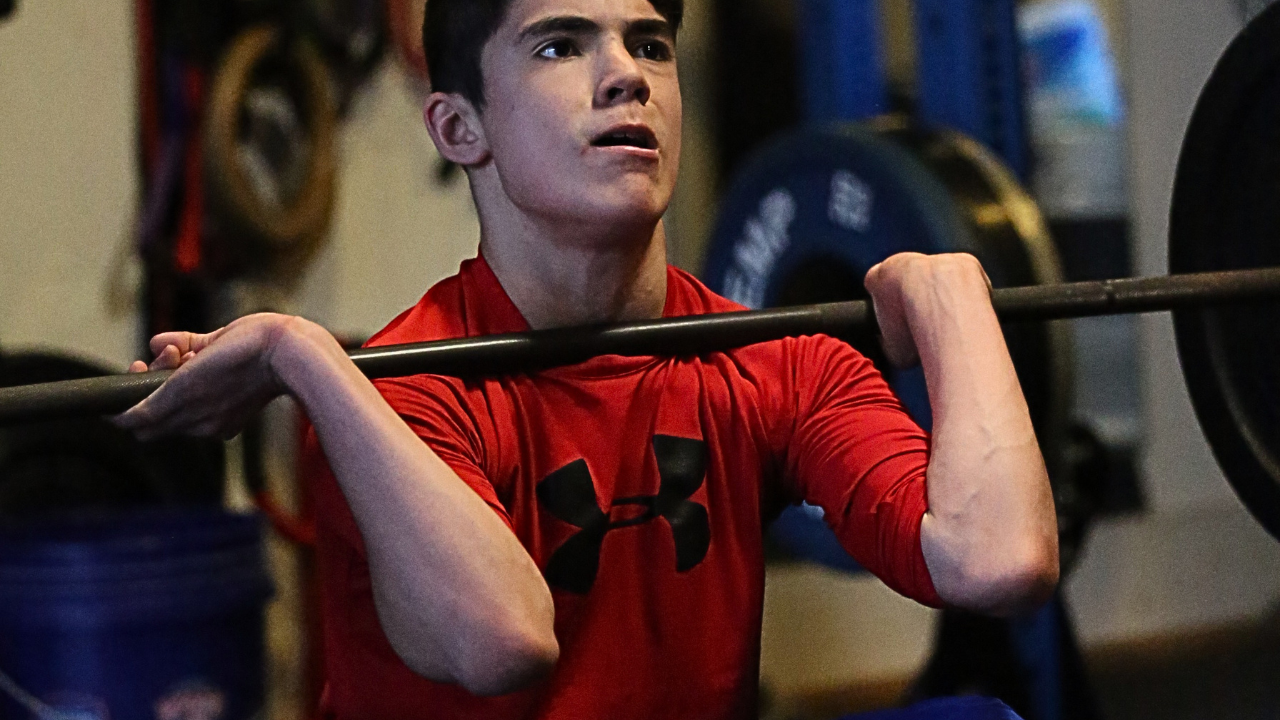
Then he has to receive the bar. In the clean that means catching a moving load in the front rack at the bottom of a squat. In the snatch it means stabilizing it overhead on locked arms while his body is still sinking. Receiving a load demands accuracy, because the bar has to land in one precise spot. It demands timing, because the wrestler has to arrive in position before the bar does. It demands balance, because all of this happens at the bottom of a squat, and it demands stability through the entire shoulder and arm complex under a live, shifting weight. That last quality decides more wrestling exchanges than parents realize. Pummeling and hand fighting are won by the shoulder that holds its position while an opponent works to move it, and the wrestler whose frames give under pressure in a scramble loses positions his legs already earned. The snatch trains that stability against a load that punishes every wobble. Count what one rep just trained: strength, speed, coordination, agility, accuracy, balance, and timing. A loaded jump trains the first two.
When my wrestlers learn to clean and snatch, they are rehearsing the full set of motor qualities that score takedowns, except the barbell version is measurable and loadable. I can watch the number go from 95 pounds to 185 and know precisely how much more violent and more precise that entire sequence has become. The mat gives me no such gauge. The bar does.
If you doubt any of this, find a piece of PVC pipe and try a snatch yourself. It weighs about a pound. If a movement cannot be performed with a broomstick on the first try, the barrier is not strength. The barrier is skill, and skill is exactly what we teach.
What to do with this
If your wrestler lifts somewhere that treats the weight room as a place to get tired, ask one question: who is coaching the movements, and what are they correcting? A room where kids grind through sloppy reps is building strength the wrestler cannot deliver, and delivered force is the only kind that scores. If you evaluate a strength program, evaluate it the way you would evaluate a wrestling practice. Look for teaching, positions, and progressions, not just sweat.
If you want to see what skilled strength work looks like structured for a wrestler, the Garage Gym Wrestling Strength Blueprint is free. It is the same movement foundation I built with my own sons, it requires a barbell and a few plates, and every lift in it is taught as what it actually is: a skill your wrestler learns once and cashes in on every match for the rest of his career.
Want the Full Training System?
Download the free Garage Gym Wrestling Strength Blueprint.
Get the Blueprint